Main Content
The Rutgers Agrivoltaics Program
In this video, Rutgers Agrivoltaics Program (RAP) Lead Dave Specca gives an overview of agrivoltaics theory and how it might help New Jersey farms maintain financial viability as well as produce clean energy for the State.
Agrivoltaics offers farmers a way to increase the efficiency of land. Using the same land for both agricultural products and energy production.
Agricultural product yields and prices can vary from year-to-year. The revenue from solar power generation sales can become a stable source of income for a farmer.
Three agrivoltaic installations were built and are being used to study crops important to New Jersey. Current research includes Hay, tomatoes, bell peppers, eggplant, soybeans, and beef cattle grazing. Insights from experiments conducted will be shared with stakeholders around the State and the region.
New Jersey Governor Phil Murphy set a goal for the State to achieve 100 percent clean energy by 2035. Part of this plan involves addressing New Jersey’s energy system, including electricity generation. The Energy Master Plan defines 100 percent clean energy by 2035 as 100 percent carbon-neutral electricity
Accelerated deployment of renewable energy like solar power generation is one strategy outlined by the governer’s office to help meet this goal. Agrivoltaics has the potential to further the renewable energy goals of the State with minimal disruption to New Jersey’s 700,000 acres of farmland production. It allows for the generation of solar power in actively farmed fields.
Crop and energy research is underway at three RAP sites, the Rutgers Agricultural Research and Extension Center (RAREC) (Bridgeton, NJ), the Snyder Research and Extension Farm (Pittstown, NJ), and the Rutgers Animal Farm (New Brunswick, NJ). A comprehensive research plan has been developed to investigate the impacts of agrivoltaics on the yield and quality of hay crops, field crops, and vegetables which are all important to NJ agriculture. Additionally, the impact of vertical bi-facial panels on pasture production and animal grazing patterns when coupled with large animal production will be investigated.
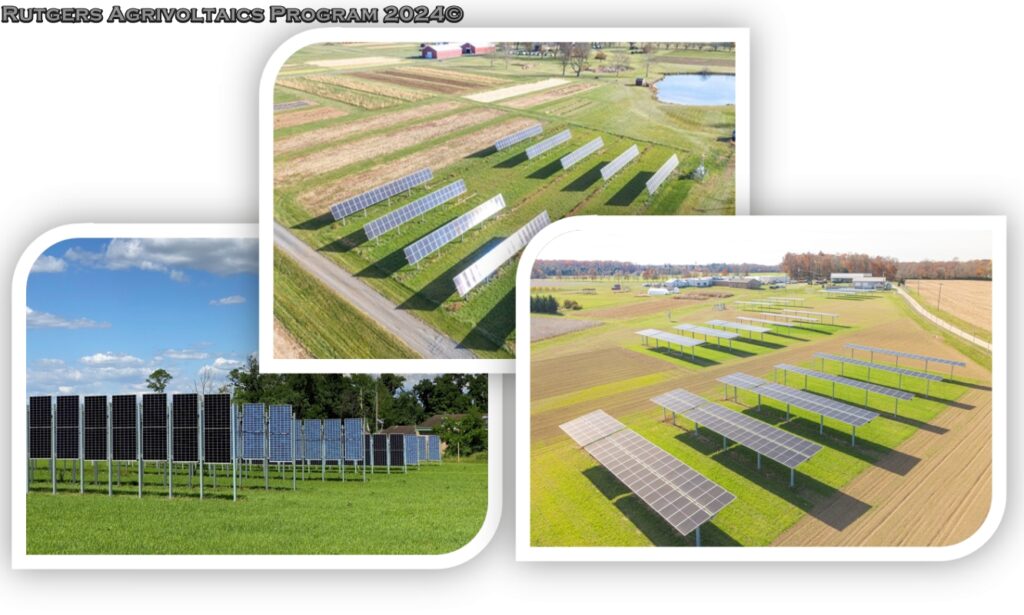
Rutgers Agrivoltaics Program (RAP) installed three agrivoltaics systems with total solar energy capacity of over 500 kW. These research and demonstration systems are located in Northern, Central, and Southern New Jersey. Funding for construction was provided through two State Appropriations totaling $2.9 million USD
Results generated from this research will inform future projects, including the Dual-Use Solar Pilot Program, and highlight the potential benefits and challenges of implementing agrivoltaics systems in New Jersey. This research will also provide the knowledge necessary for New Jersey farmers to make informed science-based decisions about adopting agrivoltaics systems, and the potential contribution of agrivoltaics systems to the State’s renewable energy goals.